Tool Evolution: Mine & Evolve
- 4.6
- Rating
- 10.00M
- Installs
- Free
- Price

 Analysis by App-foxy
I approached Tool Evolution: Mine & Evolve expecting a light adventure game built around collecting resources, but its central idea is more focused than that. Your tool is the real measure of progress: as it improves, the world opens up through different ages, and harvesting becomes the way you move forward. That gives the game a clear rhythm that is easy to understand within a few minutes. You gather, improve your equipment, reach the next stage, and repeat the process with a slightly broader sense of possibility.
That single capability is what makes the game appealing. It is not trying to be a complicated role-playing adventure with a huge cast or a dense story. Instead, developer Homa builds the experience around the satisfying connection between a stronger tool and a changing environment. I found that relationship more important than any individual resource or visual detail, because it gives even short play sessions a purpose. There is always a practical reason to keep working on the next improvement.
How tool progression shapes the adventure
The game belongs to the adventure category, but I would describe its appeal as a blend of exploration and incremental progression. The basic action is straightforward: mine or harvest what is available, then use that forward movement to evolve your tool. The design does not ask me to memorize a complicated control scheme. That makes it comfortable to pick up when I have only a few minutes, while the evolving setting gives the routine more character than a simple collection loop.
You May Also Like

 Blood Strike: 2.5 Anniversary
Blood Strike’s Loadouts Turn Every Drop Into a Tactical Gamble
A close look at Blood Strike’s custom loadouts: how fast access to signature weapons reshapes its battle royale rhythm, rewards preparation, and narrows the gap between fights.

 Pandora - Music & Podcasts
Pandora’s Music Is Easy to Start, but Harder to Recover
Pandora’s strength is its low-effort path from a seed to a station. Its weak spot is how much confidence it asks you to place in connection, setup, and quiet recovery.

 8 Ball Pool
 Is Built on Rivalries, Rematches, and Routine
A close look at the rivalries, rematches, shared routines, and unanswered safety questions that turn a quick pool match into a persistent mobile community.

 Samsung Music
’s Quiet Strength Is Playing What You Already Own
Its reach comes less from spectacle than from dependable access to a personal library. That simplicity is both the app’s strongest retention engine and its ceiling.

 AccuWeather: Weather Radar
AccuWeather Review: A Quick, Clear Forecast for Everyday Decisions
For everyday plans, the best forecast is the one you can understand quickly. AccuWeather makes rain timing, radar, and local conditions easy to act on, with a few trade-offs.

 Hill Climb Racing
Why Hill Climb Racing Still Turns Crashes Into One More Run
A tiny car, a bumpy hill and one more upgrade: Hill Climb Racing keeps resurfacing because its simple chaos makes every near-miss feel personal.
More From Our News Desk
View All News


The important distinction is that the tool is not just an accessory. It functions as the game’s main gatekeeper and reward. A better tool changes what I can do, rather than merely making an old task slightly faster. That creates a useful feeling of cause and effect. When I spend time gathering, I can see why the effort matters: the next improvement is tied directly to reaching another point in the world’s evolution.
I also like that the premise is readable without a long explanation. The short store description calls it “Tool Evolution,” and that is an accurate summary of the central interaction. The broader store summary describes crafting and harvesting in a world that evolves through the ages with every tool. In practice, the concept works because the tool gives the adventure a visible timeline. Instead of progress feeling like an abstract number, it is represented by what I carry and what that equipment allows me to approach.
That clarity makes the game suitable for players who enjoy progression but do not want to learn a large system before having fun. It is also why I would not recommend it to someone looking primarily for a narrative-heavy adventure. The attraction here is the loop of improvement and access, not a deep plot or a demanding tactical challenge.
What a normal session feels like
A typical session starts with a simple decision: keep harvesting in the current area or push toward the next tool upgrade. I usually prefer to work in short bursts, collecting enough to make the next improvement feel attainable rather than treating the game like a long uninterrupted expedition. That approach suits the structure well. The game’s strongest moments come when a modest amount of effort produces a noticeable change in what I can do next.
For example, I can imagine opening it during a commute or while waiting for an appointment. I would complete a few harvesting actions, check how close I am to the next improvement, and stop once the immediate objective is finished. The game does not need a large block of free time to communicate progress. That is a meaningful strength for a mobile title, especially for players who prefer a sequence of compact goals instead of one extended mission.
The same simplicity can become repetitive if I play for too long without a clear personal target. Since the main activity revolves around gathering and evolving the tool, the experience depends heavily on whether that loop remains satisfying for me. I found it more enjoyable when I treated each new stage as a small expedition rather than trying to rush through every upgrade. The slower approach lets the changing world do more of the work.
One useful habit is to think of each tool improvement as a checkpoint rather than immediately spending every available resource without a plan. When the next upgrade is close, concentrating on the materials needed to reach it gives the session direction. When it is still far away, a short play session may feel less rewarding, so I would stop earlier instead of forcing a long grind. This is a small adjustment, but it helps keep the progression loop from turning into background tapping.
Why the evolving world matters
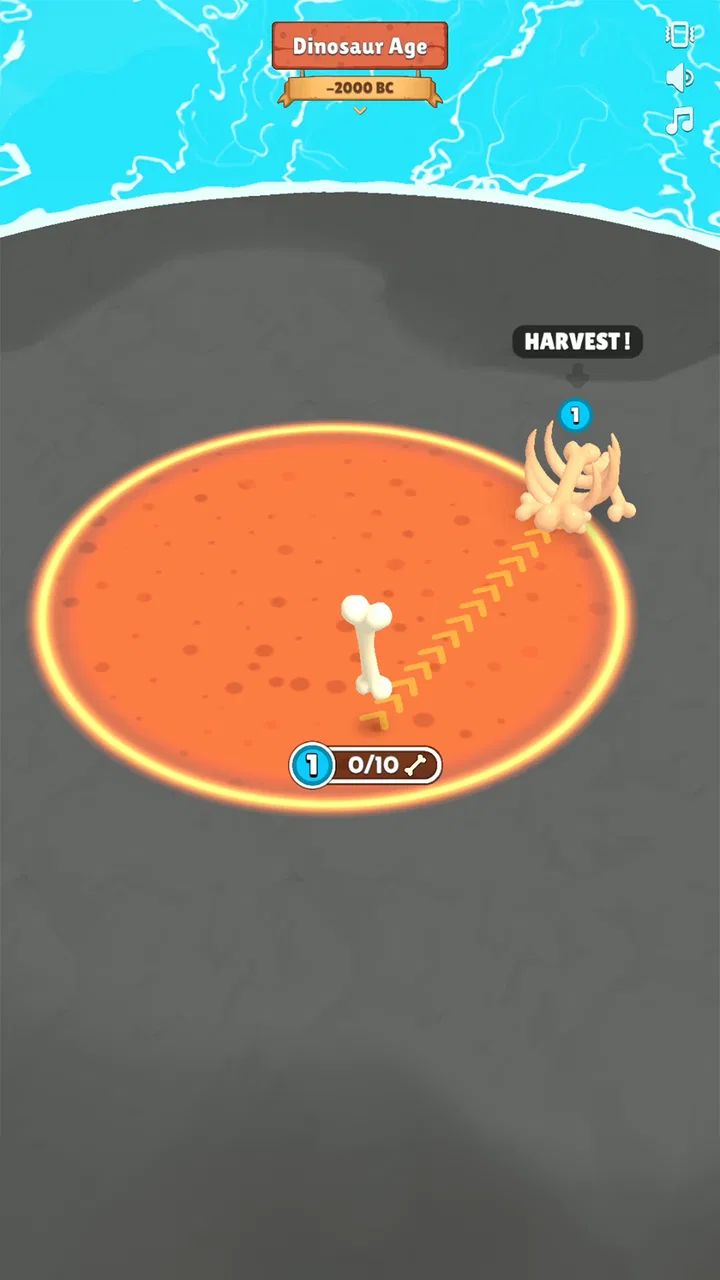
The age-based structure gives the game a sense of movement that ordinary harvesting games can lack. In a static environment, collecting resources can feel like repeating the same task with different totals. Here, the idea of moving through ages suggests that the world itself is part of the reward. The tool is therefore doing two jobs: it helps me gather, and it represents the stage of development I have reached.
I found this especially effective for players who like visible transformation. The satisfaction is less about mastering an intricate control system and more about seeing a modest starting point lead toward a more developed one. That makes the game approachable for younger players and casual adults alike. Its Everyone age rating reinforces that broad accessibility, although adults who need more complexity may eventually find the loop too light.
The age progression also gives me a reason to care about efficiency. If I am only collecting for its own sake, the activity can feel directionless. If collecting is tied to a tool that moves the world forward, each action has a clearer place in the larger journey. That does not eliminate repetition, but it gives repetition a visible destination.
Where it works best and where it falls short
I find this game works best when I treat each session as a small, self-contained step toward a tool upgrade, rather than expecting every visit to deliver a major discovery. Its main limitation is that the same clear harvesting loop can feel repetitive when I have no nearby goal to work toward. That trade-off makes it especially useful to consider how much steady, low-pressure progress I enjoy before deciding whether to keep playing.
The strongest everyday use case
The best scenario for this game is a short, low-pressure break when I want a clear objective without the commitment demanded by a larger adventure. It fits the moment between tasks: I can enter, harvest, work toward an upgrade, and leave without needing to remember a complicated quest chain. The tool-centered design is particularly helpful here because it tells me what progress means immediately.
I would also suggest it to someone who enjoys watching a system grow from a basic starting point. The appeal is similar to organizing a small project and seeing each improvement unlock a broader result, but presented through an adventure setting. It is a good choice for players who want a gentle sense of development rather than constant danger or high-pressure competition.
Another practical use is as a first adventure game for someone who finds traditional role-playing games intimidating. There is no need to begin with a large inventory of unfamiliar abilities or a long list of objectives. The tool provides a concrete anchor. A new player can understand the basic question—what can I harvest now, and what will my next improvement let me reach?—without needing genre experience.
However, I would skip it if my priority were deep exploration, elaborate storytelling, or demanding combat. The game’s identity comes from crafting, harvesting, and tool evolution. Those who want branching decisions, complex character builds, or a strong narrative voice should look toward a more traditional adventure or role-playing alternative. A farming-focused game may also be a better choice if I want detailed planting, relationships, and long-term settlement management rather than tool-led advancement.
The tradeoff between accessibility and depth
The same simplicity that makes the game welcoming can limit its long-term appeal. The controls and progression idea are easy to grasp, but players who quickly exhaust simple loops may want more layers than this format provides. I would not call that a flaw in the concept; it is a question of fit. Tool Evolution is strongest when I want a clean progression path, not when I want a simulation with many competing systems.
There is also a natural tension between harvesting and exploration. If I focus only on collecting the fastest way toward an upgrade, I risk turning the adventure into a checklist. If I slow down and pay attention to the evolving setting, the experience feels more like a journey. The game rewards a relaxed mindset, but players who optimize every action may notice the repetition more quickly.
Its free entry point makes trying that loop easy, but the presence of in-app purchases ranging from $0.99 to $19.99 per item is worth keeping in mind. I would approach those purchases cautiously and decide first whether the core harvesting cycle is enjoyable without spending. The most sensible way to evaluate the game is to play naturally, see whether the tool progression holds my attention, and treat optional spending as a convenience rather than a requirement.
That advice matters because progression games can make the next improvement feel urgent even when it is not. I prefer to set a personal stopping point before opening a purchase screen: if I am only interested because I feel impatient, I wait and return later. If I am still enjoying the activity itself, the free experience has already answered the most important question about whether the game suits me.
Small strategies that improve the experience
My first tip is to use the tool upgrade as the session’s main objective. Rather than harvesting without a clear endpoint, I decide whether I am trying to reach the next improvement or simply exploring the current stage. This avoids the vague feeling of doing work without knowing what it is for.
Second, I would avoid judging the game during a single rushed session. Its appeal depends on the connection between several small actions and a later change in the world. If I stop before that connection becomes visible, it can seem like a basic mining game. Once the tool begins to represent a new age, the broader design makes more sense.
Third, I recommend alternating focused resource gathering with slower exploration. Concentrating only on the most efficient route may shorten the time to an upgrade, but it can make the world feel like a backdrop. Allowing myself to pause and experience the current stage makes the age-based structure more noticeable and helps prevent the loop from becoming mechanical.
A final practical point is to match the game to my energy level. When I want a calm activity, the predictable tool cycle is a benefit. When I want surprise, challenge, or a strong sense of urgency, it is probably the wrong choice for that moment. Recognizing that difference has made my sessions more enjoyable than expecting the game to provide every type of adventure at once.
Who benefits most from the design
The best audience is made up of casual players who like collecting, gradual upgrades, and a world that changes in response to progress. It is also a good fit for families because the Everyone rating and uncomplicated premise make the initial learning curve approachable. I can see younger players enjoying the direct reward of a better tool, while adults may appreciate the short-session structure.
Players who enjoy idle-style advancement may also find familiar comfort here, although the game still feels more active because harvesting is the central interaction. It sits between a passive progression experience and a conventional adventure. That middle ground is useful for someone who wants to participate without dealing with a demanding combat system or a large strategic map.
The audience is less clear for experienced adventure fans who need layered objectives. If I want every resource to feed into a complex crafting tree, or if I expect a substantial narrative to justify each new area, I may outgrow this experience. Likewise, competitive players looking for leaderboards or direct multiplayer pressure should choose a game built around those priorities instead.
Its popularity suggests that the accessible formula has found a broad audience: it carries a 4.6 average from around 109 thousand ratings and has passed 10 million installs. Those figures do not replace personal testing, but they do match my impression that the concept is easy for many people to understand. The game has been available since February 9, 2024, and version 2.10.0 is the current version, so I would keep the app updated when possible to use the current build.
My final recommendation
I recommend Tool Evolution: Mine & Evolve when I want a friendly adventure built around one clear idea: improving a tool changes how I interact with the world. That focus is the reason to play it. The game turns harvesting from a repetitive chore into a visible path through different ages, and it works particularly well in short sessions where a concrete next upgrade is enough motivation.
I would still keep expectations realistic. This is not the right pick for a complex role-playing campaign, a detailed farming simulation, or a high-pressure action game. Its charm comes from a narrower promise, and the experience is most satisfying when I accept that simplicity instead of asking it to provide systems it was not designed around.
Because it is free to start and rated for Everyone, I think it is easy to recommend as a low-risk experiment. I would play far enough to see whether the tool-to-world connection keeps me interested, then decide whether the later progression feels rewarding enough to continue. For me, the game succeeds when I treat each session as a small step into a new age rather than a race to maximize every resource.
The tool is more than equipment here: it is the game’s map, progress marker, and reason to keep exploring. If that kind of steady, uncomplicated evolution sounds satisfying, Homa’s adventure is worth trying. If I need richer stories or deeper systems, I would choose a more traditional alternative instead.
FAQs for Tool Evolution: Mine & Evolve
01What is the main objective of Tool Evolution: Mine & Evolve?
In Tool Evolution: Mine & Evolve, the main objective is to mine resources and evolve your tools from primitive to advanced. Players start with basic tools and, through strategic mining and resource management, can upgrade to more efficient and powerful equipment, enhancing their ability to progress through different levels.
02Is Tool Evolution: Mine & Evolve free to play?
Yes, Tool Evolution: Mine & Evolve is free to download and play. However, the game includes in-app purchases that can enhance gameplay. Players have the option to buy resources or special tools, but these purchases are entirely optional and not necessary to enjoy the core experience.
03What platforms is Tool Evolution: Mine & Evolve available on?
Tool Evolution: Mine & Evolve is available on both Android and iOS platforms. Players can download it from the Google Play Store for Android devices and the Apple App Store for iOS devices, ensuring a wide accessibility for mobile users.
04Does Tool Evolution: Mine & Evolve require an internet connection?
Tool Evolution: Mine & Evolve can be played offline, making it convenient for users who do not have constant internet access. However, certain features, like in-app purchases and leaderboards, require an internet connection to function fully.
05Are there any age restrictions for playing Tool Evolution: Mine & Evolve?
Tool Evolution: Mine & Evolve is suitable for players ages 10 and up. The game is designed to be family-friendly, with no graphic violence or inappropriate content, making it an enjoyable and safe choice for younger audiences as well as adults.
Pros
- Engaging gameplay with evolving tools.
- Intuitive controls make it easy to play.
- Visually appealing graphics and design.
- Regular updates introduce new features.
- Offers offline mode for on-the-go play.
Cons
- In-app purchases can be costly.
- Progress can feel slow without spending.
- Occasional ads interrupt gameplay.
- Limited character customization options.
- Requires a stable device for smooth play.

Tool Evolution: Mine & Evolve
Gallery